Water from Heaven by Robert Kandel
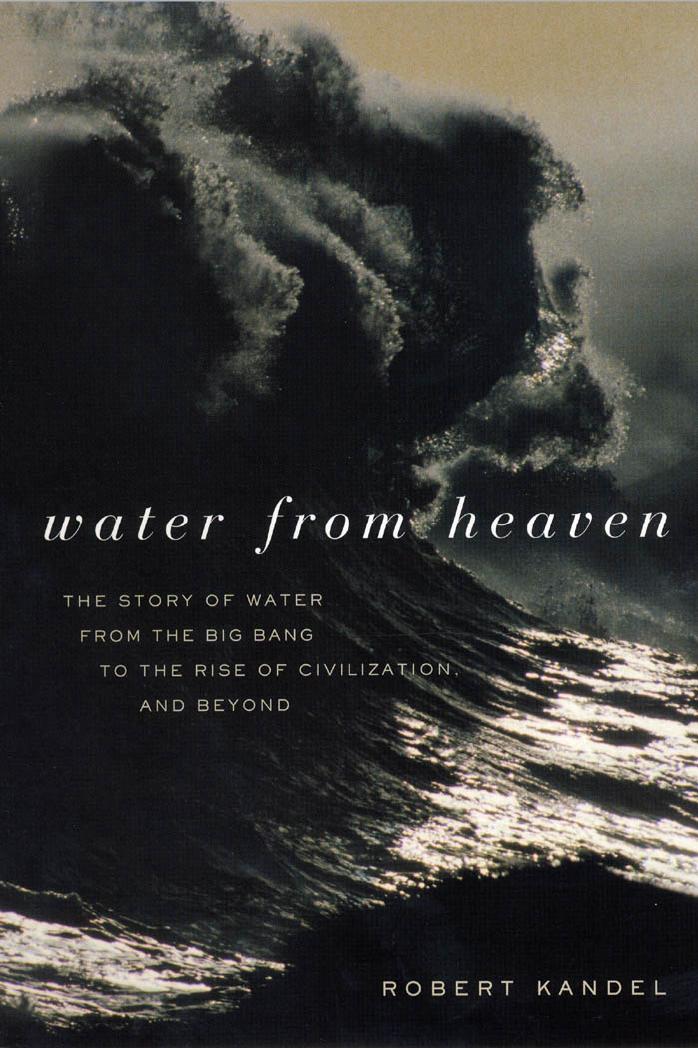
Author:Robert Kandel
Language: eng
Format: epub, pdf
Tags: SCI019000, Science/Earth Sciences/General, SCI020000, Science/Life Sciences/Ecology
Publisher: Columbia University Press
Published: 2003-03-17T05:00:00+00:00
CHAPTER 10
EARTH’S WATER, BETWEEN SKY AND SEA
WATERSHEDS AND WATER FLOWS
Water falls from the skies, and all open-air creatures large and small depend on its fleeting or prolonged passage over the land. Source and stuff of all life on our planet, water evaporates from the sea to return to the sea. But the water cycle does not follow a single track, and its many ramifications involve byways, bottlenecks, detours, and dead ends. Of the rain falling on land, two-thirds return rapidly to the atmosphere, evaporating in a matter of hours directly from soil and leaf surfaces, more slowly over days or weeks from rivers and lakes (table 6.1 and fig. 6.1). By contrast, water falling as snow may accumulate for months on the plains, for years, centuries, or millennia on high mountains or in the polar zones. Thanks to these slower stages in the race of water to return to the sea, crops growing in dry summer weather can still pump the precipitation of last winter, or even of previous wetter years. And thanks to the prolonged imprisonment of water in polar and mountain ice, twentieth- and 21st-century scientists have been able to study climates of yesteryear, indeed of hundreds of thousands of years ago.
At any moment, the world’s streams and rivers contain only 2,000 cubic kilometers of freshwater (each cubic kilometer being a billion cubic meters or metric tons). But considering the total stream flow of water in all those streams to the sea (about 40,000 cu. km per year; see fig. 6.1), they must empty themselves and be renewed about twenty times every year. On average, water’s “residence time” in rivers and streams is thus about eighteen days. The average can be misleading: fortunately, most rivers do not dry up after a month of drought. Lakes contain some fifty times more of the world’s freshwater than do the rivers themselves, and when, as for the Nile, large lakes store part of the river’s water supply, they provide a reserve for the dry season. In North America, some of the water entering the Saint Lawrence River spends as much as 300 years in the Great Lakes. These inland freshwater seas contain about 60,000 cu. km of water, a substantial share of the total freshwater in liquid form on the Earth’s surface. Similarly, water spends 400 years in the depths of Siberia’s Lake Baikal (23,000 cu. km), before it joins (at 53 cu. km per year) the Angara River flowing to the Arctic Ocean. In western Europe, the 38 cu. km of water in Lake Leman (Lake of Geneva) between France and Switzerland correspond to 250 days of Rhone River flow (partly maintained by the melting of Alpine glaciers); further north, Lake Ladoga with 908 cu. km of freshwater stocks twelve years’ worth of the Neva River, only 74 km long, flowing through the beautiful city of Saint Petersburg (Russia) into the Gulf of Finland.
Lakes play a less important role for most other major rivers; or at least they used to, in an earlier natural state.
Download
This site does not store any files on its server. We only index and link to content provided by other sites. Please contact the content providers to delete copyright contents if any and email us, we'll remove relevant links or contents immediately.
Whiskies Galore by Ian Buxton(42078)
Introduction to Aircraft Design (Cambridge Aerospace Series) by John P. Fielding(33175)
Small Unmanned Fixed-wing Aircraft Design by Andrew J. Keane Andras Sobester James P. Scanlan & András Sóbester & James P. Scanlan(32835)
Aircraft Design of WWII: A Sketchbook by Lockheed Aircraft Corporation(32330)
Craft Beer for the Homebrewer by Michael Agnew(18286)
Turbulence by E. J. Noyes(8112)
The Complete Stick Figure Physics Tutorials by Allen Sarah(7422)
The Institute by Stephen King(7089)
The Thirst by Nesbo Jo(7002)
Kaplan MCAT General Chemistry Review by Kaplan(6988)
Bad Blood by John Carreyrou(6669)
Modelling of Convective Heat and Mass Transfer in Rotating Flows by Igor V. Shevchuk(6495)
Weapons of Math Destruction by Cathy O'Neil(6362)
Learning SQL by Alan Beaulieu(6344)
Man-made Catastrophes and Risk Information Concealment by Dmitry Chernov & Didier Sornette(6138)
Permanent Record by Edward Snowden(5890)
Digital Minimalism by Cal Newport;(5835)
Life 3.0: Being Human in the Age of Artificial Intelligence by Tegmark Max(5617)
iGen by Jean M. Twenge(5454)
